





It has been said that there are two things of which we may be certain in life: death and taxes. This sentiment is often attributed to Benjamin Franklin. The Bible certainly teaches both the certainty of death (Hebrews 9:27) and the reality of taxes (Matthew 17:24–27). To this list of certainties, I am sure we could add a few other items, even from our weekly routines. We fill the sink with dirty dishes, and we empty a tank of gas. We make and unmake the bed, stock and unstock the fridge, and roll the trash can to and from the curb. Perhaps the most certain and despised chore of all would be the never-ending cycle of laundry.
Many of our homes come equipped with an entire room devoted to this chore. We have machines and powders and special stain treatments to make the task more efficient. Yet for all our efforts at cleaning clothes, we still run into the occasional stain that refuses to come out, the unfortunate shrinking of a favorite item, or the loss of a sock that renders the pair useless. Yes, we can add the frustrations of laundry to the list of certainties in life.
When Joshua Stood Before God in Filthy Clothes
The high priest Joshua son of Jehozadak was a man acquainted with the frustrations—to put it lightly—of dirty laundry. In a vision given to the prophet Zechariah, he was standing before the angel of the Lord “dressed with filthy clothes” (Zechariah 3:3). As the high priest, Joshua was prescribed the most beautiful, intricate garments among the people of Israel. His outfit would have included “a breastpiece, an ephod, a robe, a specially woven tunic, a turban, and a sash” (Exodus 28:4). These holy garments would have been made with the most vibrant blue, scarlet, and purple yarn and the finest linen. The high priest’s garments would be embroidered with gold. The breastpiece would be adorned with gold filigree in its settings for twelve stones, including emerald, amethyst, and diamond.
These twelve stones stood for the twelve tribes of Israel, which the high priest represented before the Lord when he would approach the altar to make atonement for their sins. (You can read about these and other details of the high priest’s clothing in Exodus 28.) The final verse of Exodus 28 concludes: “These must be worn by Aaron and his sons whenever they enter the tent of meeting or approach the altar to minister in the sanctuary area, so that they do not incur guilt and die. This is to be a permanent statute for Aaron and for his future descendants” (Exodus 28:43).
Joshua was one of those descendants of Aaron, and on this occasion, he stood before the angel of the Lord dressed in filthy clothes. Why wasn’t he wearing his priestly clothes? Context is important here. Zechariah writes after Judah’s exile, during the reign of the Persian king Darius (Zechariah 1:1). When the Babylonians invaded Jerusalem, they sacked and burned the temple (see 2 Kings 25:8–17). But the filthy clothes in this vision point to something deeper: Joshua is wearing soiled garments, a symbol for his own sins and the sins of the nation.
This did not bode well for Joshua or for his people, especially since there also stood at his right hand an accuser: “Then he showed me the high priest Joshua standing before the angel of the LORD, with Satan standing at his right side to accuse him” (Zechariah 3:1). Satan accused Joshua of more than a mustard stain on his tunic or spit-up on his robe. Satan was there to accuse Joshua of his iniquities. Talk about a bad day!
Here stands the man chosen to make atonement for the sins of God’s people. He is poorly dressed, he is guilty of his own sins, and Satan himself is there to make sure God gives this man what he deserves: the death penalty. There was nowhere to hide. There was no spare change of clothes. There was no way to escape the holy gaze of the Lord of Armies.
The Greatest Makeover in History: Filthy Clothes Traded for Festive Robes
At that moment, the Lord interrupted Satan’s accusations, not with a sentence of condemnation for Joshua but with a sharp rebuke against his accuser: “The LORD said to Satan, ‘The LORD rebuke you, Satan! May the LORD who has chosen Jerusalem rebuke you! Isn’t this man a burning stick snatched from the fire?’” (Zechariah 3:2). The Lord comes to the defense of Joshua, calling him a brand plucked from the fires of God’s wrath. In other words, Joshua has been snatched from sure and utter destruction by the mercy of God.
In response, the angel of the Lord tells those nearby, “‘Take off his filthy clothes!’ Then he said to him, ‘See, I have removed your iniquity from you, and I will clothe you with festive robes’” (Zechariah 3:4). The angel has Joshua stripped of his filthy clothes, which represent not only a defiled priest but a sinful nation (remember the twelve stones, which represent the twelve tribes of Israel). In this way, he removes the iniquity from the high priest and the nation he represents. As the psalmist declares, “As far as the east is from the west, so far has he removed our transgressions from us” (Psalm 103:12).
We see in this statement that the priest’s dirty clothes were simply symbolic of a deeper heart issue. Joshua and his people had sinned against the Lord. They needed a more sufficient covering than the clothes of the priesthood. They needed “festive robes” or “pure vestments” (Zechariah 3:4, ESV) from the Lord Himself. No amount of washing powder or stain remover could rid the people of what defiled them from the inside out. No clothing would be sufficient to hide their sin nature from the God who sees all things.
Having thoroughly silenced Satan and stripped the priest of his filthy garments, the Lord moves to put clean clothes on Joshua: “Then I said, ‘Let them put a clean turban on his head.’ So a clean turban was placed on his head, and they clothed him in garments while the angel of the LORD was standing nearby” (Zechariah 3:5). Joshua is the subject of the greatest makeover in history as the angels dress him in clean, pure vestments.
Jesus, Our Better High Priest, Clothes You in His Righteousness
With this new wardrobe came new access. The angel of the Lord assures Joshua, saying, “This is what the LORD of Armies says: If you walk in my ways and keep my mandates, you will both rule my house and take care of my courts; I will also grant you access among these who are standing here” (Zechariah 3:7). We understand how our clothing and accessories can provide us unique access. Think of the ID badge, the company uniform, or the matching logo. Once, I showed up at an unfamiliar funeral home to preach a funeral, and simply by virtue of my suit and tie and the Bible in my hand, the director approached me and said, “You must be the pastor.”
In this verse, we see that Joshua is granted access to the heavenlies by virtue of his new clothes and what they represent. The man once destined for the fire now has free access to the throne of grace. He has also been entrusted with new privileges and responsibilities. The Lord allows him to rule in His house and charges him to care for His courts. None of these things are given to Joshua on his own merits. He did not earn this promotion. He didn’t dress the part. He didn’t ace the interview. Rather, the Lord of Armies snatched him out of the fire, cleaned him up, and graciously entrusted him with a place of service and access to God.
Joshua is told to walk in the Lord’s ways and to keep His mandates, and God has provided everything he needs to do so. And God provides us with everything we need to enjoy free access to the throne of grace. Like Joshua, even our best garments are not clean enough. Isaiah tells us that our righteous acts are like a “polluted garment” (Isaiah 64:6). Scripture describes God clothing us with His righteousness through His grace: “I rejoice greatly in the LORD, I exult in my God; for he has clothed me with the garments of salvation and wrapped me in a robe of righteousness, as a groom wears a turban and as a bride adorns herself with her jewels” (Isaiah 61:10).
Our own righteous acts cannot remove the stain of sin. We need something stronger, something purer. We need the righteousness of God in Christ: “and be found in him, not having a righteousness of my own from the law, but one that is through faith in Christ—the righteousness from God based on faith” (Philippians 3:9). In those moments when Satan accuses you of your sins, seeking to condemn you before a holy God, cling all the tighter to Jesus, who is your festive robe, your pure vestment.
Joshua was high priest for God’s people, and he needed atonement for his own sins. But Jesus is the greater High Priest who made atonement for our sins by offering Himself. He is “the Branch” that Joshua and his fellow priests were “a sign” of (Zechariah 3:8). He was without sin, yet He took on our filthy garments and died in our place to pluck us from the fire of God’s wrath (2 Corinthians 5:21). God raised Him from the dead for salvation, and He sits at the right hand of the Father interceding for us now and silencing the accusations of Satan (Romans 4:25; 8:33–34; Hebrews 10:12–13).
When the dirty laundry piles up, remember the One who clothes you with clean vestments. Let that dreaded chore remind you of the precious mercies of God. Rejoice that you do not have to clean yourself up for Him, for He has provided you with the finest of clothes, granted you access to relationship with Him, and charged you to walk in His ways.
If you liked this article, check out the related resources linked below!
Unlock a 10% off coupon!
Related Resources:
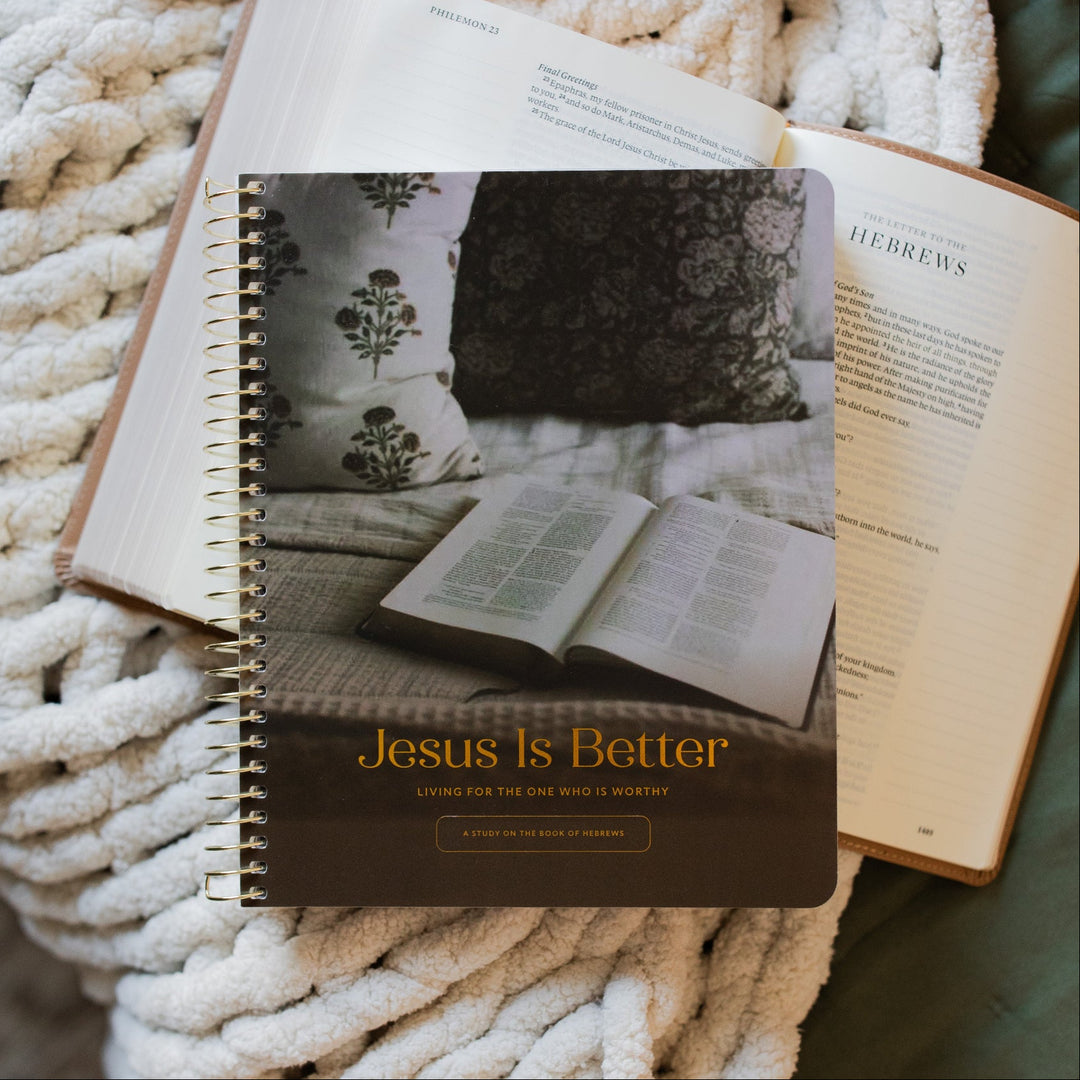
| Jesus Is Better | Hebrews Bible Study | Free From Shame Bible Study | Rhythms of Confession (and Why It's Good) | |||
 Loading price… |
 Loading price… |
 |
|||
| Add to Cart | Add to Cart | View Blog |