






I love talking about books.
In everyday conversations, I’ve developed my own version of Murphy’s Law, and it goes something like this: Any subject that can go back to books will go back to books. (I have yet to find one that won’t.) I especially love talking about my favorite books—the ones I come back to time and time again whose yellowed pages greet me like a faithful friend yet always seem to have something new for me to discover. And while my home library is chock full of books from my favorite theologians and philosophers, it is simply overflowing with fairy tales. Indeed, there is a piece of my heart tucked snugly between the pages of each fiction book I have read and loved; in return, there is a piece of that book tucked in some safe crevice of my soul where it first spoke to me.
As someone who works in a thinking industry alongside a lot of smart people, my love of fiction can come as a surprise when it inevitably emerges in conversation. For instance: In a recent discussion with a friend who’s getting back into the practice of reading regularly, I can’t begin to describe the look on his face when I told him my favorite book is Bram Stoker’s Dracula. It was nothing short of comical.
“Dracula?!” he exclaimed—as if he hadn’t heard me correctly. (Or as if I’d said Twilight.) “Like. . . Dracula Dracula?”
Yes, Dracula Dracula. (It’s basically a medieval romance about good triumphing over evil—what’s not to love?) But this kind of response is commonplace in Christian circles when it comes to certain types of literature, particularly fiction; for many of us, books falling under this category may seem optional at best and self-indulgent at worst. They are often even labeled as “bad influences” across the board. While there is certainly something to be said for discernment within our reading habits, I think we do an equal amount of damage when we write fiction off wholesale as either harmful or childish without considering how it might be used as a legitimate means of spiritual formation.
Fiction As Spiritual Formation
The title of this blog is adapted from George Orwell’s 1936 essay in which he argues that “the novel is worth salvaging and. . .in order to salvage it you have got to persuade intelligent people to take it seriously.”1 Though writing in a slightly different context, his sentiment is parallel to my own when it comes to the value of reading books that feed both the mind and the heart. I know many everyday Christians who aspire to read at a higher level, hoping to tackle complex works of theology and ancient texts of the church fathers—and this is undoubtedly a worthy pursuit. I encourage any Christian to do so! But how often do we include fiction, fairy tales, and poetry in our toolkit of spiritual formation? How often do we find ourselves picking up a book simply for the pleasure of reading it?
I frequently have this (admittedly rather one-sided) conversation about the purpose of reading with my dad. I give him books I think he’d enjoy and he relentlessly teases me for putting so much stock in “made-up stories.” I mean, what’s the point of reading a book that won’t teach you something practical? It’s a fair question. But I’d argue that part of being well-read is understanding all the different ways in which wisdom grows in us—and not all of those avenues are as obvious as we might think. Learning about our God and His story of redemption is not restricted to theological commentaries and pastoral nonfiction, or even the goldmine that is the writings of the church fathers. There is much to be gleaned from Tolkien and Augustine alike if only we know how to absorb it; if only we recognize that the art of story can be as enriching to our spiritual lives as any good sermon.
Storytelling is, after all, a way of partaking in the skill that is most natural to us because it is an echo of our Creator’s genius. When we thoughtfully engage with stories, we are meeting ourselves at our own foundation—at an intrinsic part of who we are as human beings. Storytelling is not mere entertainment, nor is it some secondary vice that clouds our understanding of real things. It is coded into our DNA by the first and greatest Storyteller who breathed life into creation and then wrote Himself into the narrative. How, then, can we deny the power of story when before us stands the Word made flesh (John 1:1)? How can we say that stories don’t matter when we are living inside the best story ever told, one that begins and ends with its Author (Revelation 22:13)?
A Baptism of the Imagination
I remember the first time I read C. S. Lewis’s Space Trilogy—his three-part interplanetary fantasy series following a middle-aged philologist who unwittingly becomes a major player in the cosmic battle between good and evil. Perelandra, the second book of the trilogy, did more than entertain me; it changed the way I thought about my relationship with God. Much of this book I read through a blur of tears, understanding on a soul-deep level—perhaps for the first time!—just what had been lost in Eden. It was instrumental in transferring the Christian ideas I’d heard all my life from my head to my heart.
To know that God loves you is a wonderful thing—but what about to feel it? What might it be like to read your own story in someone else’s words? To see yourself as you really are: a lowly, wretched creature whose Creator—incredibly—considers more precious than diamonds? This is, in the really good stories, what Lewis calls a baptism of the imagination. For him, it was George MacDonald’s Phantastes that awoke his heart of hearts to spiritual realities all around him. For me, it was Perelandra.
This is why I will always defend fiction; even the fiction that is not explicitly Christian. It taps into a recess of our souls that cannot be touched by mere knowledge. It “can give us experiences we have never had and thus, instead of ‘commenting on life’, can add to it.”2
There is only so much theology we can hold with our intellects. Often, the deepest spiritual truths pierce us through the backdoor of imagination.
We were created with imagination; to seek out what is true, good, and beautiful even beyond the limits of our rational understanding. We possess a built-in craving for more—our souls reach out for God’s eternal kingdom as a sunflower stretches up toward the sun. And His warm rays of divine light can come to us in a myriad of beautiful ways: In the small gift of a friendly smile, in the simple pleasure of a hot meal on a cold night, and even in the final words of an enchanting fairy tale.
As creatures tenderly cared for by the very Storyteller who first wove us together, may we consider our reading, too, as an opportunity to come face-to-face with His love. May we engage with literature prepared to read His story between the lines—because it is the one story that unites all the others. Yours, mine, and the generations who went before and will come after us. Story matters. And I hope we never stop taking joy in it.
So do yourself a favor today and pick up a book. Even if it’s a made-up story. Even if it’s a fairy tale.
You might just learn to see with new eyes.
Notes:
-
George Orwell, “In Defence of the Novel.”
-
C. S. Lewis, On Stories, 72.
Author Bio:
Audrey Dial is a Staff Editor for The Daily Grace Co.® She lives in Houston, Texas, where she serves as the neighborhood chronicler of toadstools and her cat’s emotional support human. In her spare time, she can be found writing, reading medieval poetry, or enjoying a cup of tea.
Unlock a 10% off coupon!
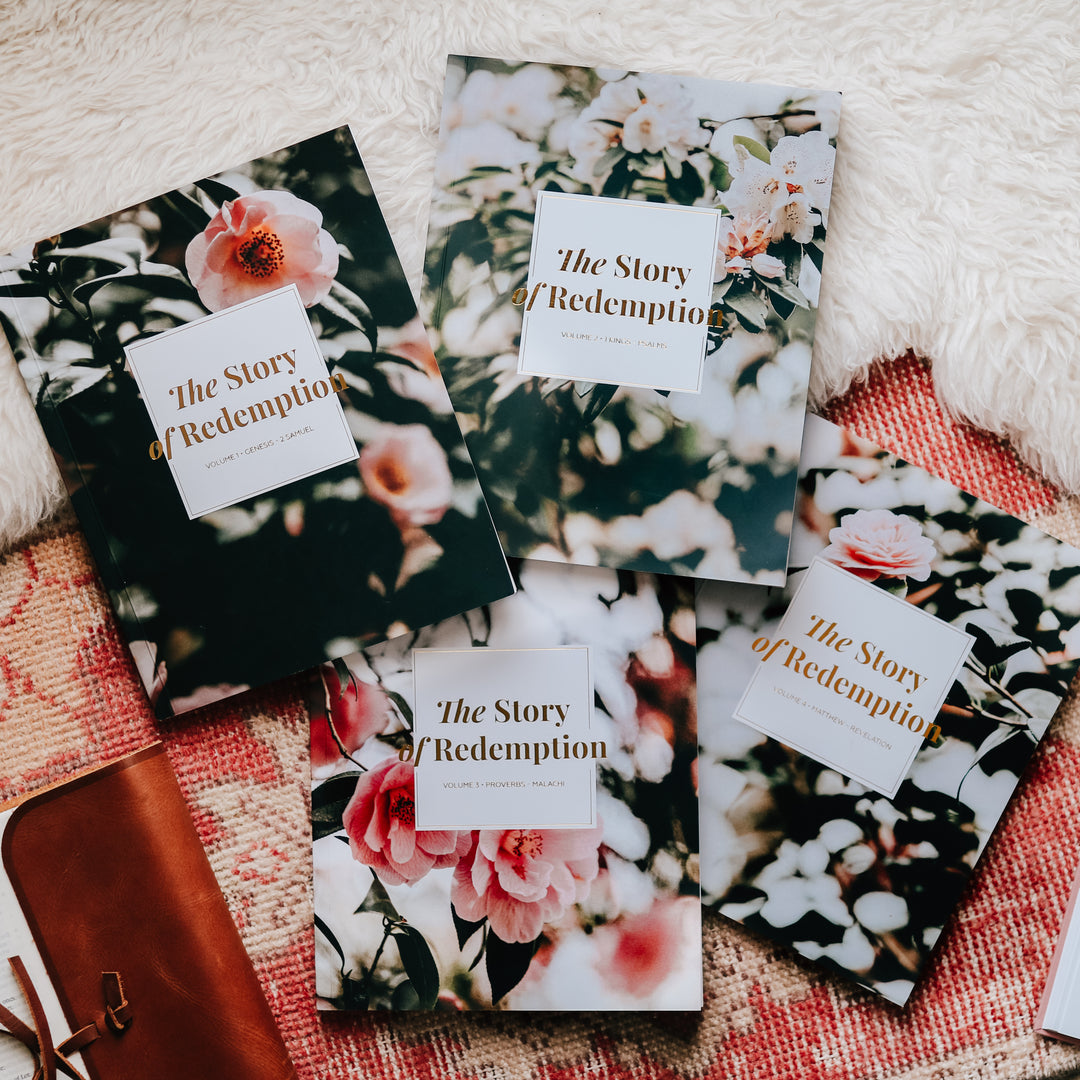
Additional Resources for Engaging With God’s Big Story:
| The Story of Redemption Bible Study Bundle | Come and See | Bible Study on John | Clinging to the Cross - Lent Bible Study | In Christ Alone | Romans Bible Study - Men's | ||||
 Loading price… |
 Loading price… |
 Loading price… |
 Loading price… |
||||
| Add to Cart | Add to Cart | Add to Cart | Add to Cart |