





There are moments I wish I could undo: words I’ve said, choices I’ve made, patterns that seem impossible to break. The weight of guilt and shame does not just come from one failure but from a deeper sense that something in me is fractured.
That struggle isn’t new. It didn’t begin with us, but in an ancient garden. To understand why we feel this way, we must go back to the first man, Adam, whose one act of disobedience changed everything.
From the first page to the last, Scripture traces a single rescue story. God creates, humanity breaks, Christ restores. At the center of the story is a striking comparison of two men: Adam and Jesus. Romans 5:12–21 shows us that Jesus is the second and truer Adam. Where Adam failed, Jesus succeeded. Where Adam brought death into the world, Jesus brings life.
This theological reality is packed with gospel implications. Following one man leads to death; following the God-man leads to eternal life. Let’s explore how Jesus fulfills what Adam never could and thereby gaze at the beauty of our Savior.
The First Man
In Genesis 1–2, we are introduced to the first man, Adam, who is made by God, in His image, out of the dust of the ground (Genesis 2:7). After God placed Adam in the garden, He tasked him to work and keep it (Genesis 2:15). While this may sound like a dream job for all gardeners, there is more at stake. The Hebrew words used to describe Adam don’t just describe a gardener; they describe a priest. Adam was given a priestly function and was the guardian of God’s presence.
The garden of Eden was therefore a sanctuary where God dwelt among His people. Adam, in his priestly role, functions as a representative for all humanity. This priestly role does not last long, though, as Genesis 3 tells us that instead of guarding the garden, he lets the serpent in. Instead of upholding the word of God, he chose rebellion. Our representative failed.
Now, sin has splintered what was once “very good” (Genesis 1:31). Shame entered their hearts (Genesis 3:7), and they hid themselves out of fear (Genesis 3:10). We still feel the effects of his failure today. Romans 5:12 says, “ Therefore, just as sin entered the world through one man, and death through sin, in this way death spread to all people, because all sinned.”
Praise God the story doesn’t end there.
The Need for a Better Adam
If the Bible concluded here, the results would be devastating. Thankfully, in Genesis 3:15, God revealed a hope for a brighter future and a Redeemer who would undo the mess of sin when He told the serpent that a son of Eve “will strike your head and you will strike his heel.”
What has been made visible is our need for not just another representative but a faithful priest—a faithful priest who would guard what is holy, obey God perfectly, and redeem access to the presence of God.
Jesus: The Better Adam and the True High Priest
As you fast forward through the Old Testament, the system of sacrifices, laws, and priesthood never could fulfill redemption completely. The sacrificial system demanded continual payments for sin, which pointed to our need for a final and complete sacrifice.
Arriving at the New Testament, we see how Jesus is the perfect Prophet, Priest, and King. He is called the “last Adam” (1 Corinthians 15:45), and He steps into human history yet lives without sin. He is the better and truer Adam because:
- While Adam failed in the perfect garden, Jesus succeeded in the wilderness by resisting Satan.
- On His way to the cross, He agonized in the garden of Gethsemane, showing that obedience is not based on circumstances. Adam effectively wanted “my will, not Yours,” while Jesus prayed to the Father, “Not my will, but yours be done” (Luke 22:42).
- Adam let his priestly role of guarding fail with the serpent and did not defend truth, while Jesus guarded the truth without compromise (Hebrews 4:14–15).
- Adam was the “federal head,” which acts as a legal representative. When he fell, we fell with him; when Jesus won, He won on our behalf. Now, access to the Holy of Holies (the place where God’s presence resided in the temple) is available to all who place their faith in Him.
Romans 5:19 says, “For as by the one man’s disobedience the many were made sinners, so by the one man’s obedience the many will be made righteous” (ESV). This verse describes the vast contrast between Adam and Jesus. Romans 5:18 tells us that Adam's disobedience brought condemnation. Jesus, however, lived in perfect obedience. Hebrews 4:15 reminds us that He “has been tempted in every way as we are, yet without sin.”
Instead of receiving an earthly reward for His obedience, Jesus went to the cross: “He himself bore our sins in his body on the tree” (1 Peter 2:24). On that tree, Jesus bore the full weight of Adam’s sin and ours. He endured the punishment and the consequence that we deserved so that we might receive grace.
As Jesus died on the cross, He declared, “It is finished” (John 19:30). He was placed in a tomb, and three days later He rose to life defeating Satan, sin, and death once and for all. First Corinthians 15:22 declares, “For just as in Adam all die, so also in Christ all will be made alive.”
Adam’s choices lead to death. Jesus’s obedience lead to life for all who believe.
Living in the New Reality
If our understanding of Jesus as the better Adam was purely theological, we would miss the point. In all the Scriptures we’ve examined, the thrust behind them is not to expand our head knowledge but to have our affections stirred for Jesus. Christian, you are a new creation in Christ; the old is gone, and the new has come (2 Corinthians 5:17)!
So what implications does this have for our lives?
First, Jesus secures our salvation. Jesus has already accomplished what we could never accomplish ourselves. The old sacrificial system is gone, and Jesus has made a way for us to be reconciled to him.
Second, our understanding of Jesus as the better Adam strengthens us to fight sin. Jesus is the Overcomer we can draw near to for help: “let us approach the throne of grace with boldness, so that we may receive mercy and find grace to help us in time of need” (Hebrews 4:16).
Third, that Jesus is the better Adam allows us to reevaluate how we see ourselves. In Adam, there is a constant strain to prove our worth and a deep shame when we fail. But Christ now defines us, replacing the identity we inherited from Adam. In a fractured world, we turn our eyes to the One who looks at you and calls you His own.
A Restored Garden
The biblical narrative doesn’t just begin in the garden; it ends with one.
In Revelation 22, we are given a glimpse of what Jesus has secured for us: a river of the water of life coming from the throne of God. And on either side is the Tree of Life bearing fruit and its leaves providing healing to the nations (Revelation 22:2). Jesus now freely gives the access that He once guarded. Jesus restores everything we once lost.
There is coming a day when there will be no more curse for sin. No more separation. No more death. No more striving to give back to God. Instead, the intimacy that was broken in Eden will finally be restored and forever made whole because we will see His face (Revelation 22:4). And at the center of it all is Jesus—the better Adam and our faithful High Priest.
When life feels fractured or unfinished, remember this: The story is not over. The garden is not gone; it’s coming. Because of Jesus, the better Adam, what was once lost will be restored, and as we were always meant to do, we will finally live in the presence of God.
Author Bio:
Matt Duckett serves as the Lead Pastor at First Southern Baptist Church in Lawrence, Kansas. He is passionate about seeing lives transformed by the life-changing message of the gospel. Matt lives in Lawrence with his wife, Sarah, and their two sons. He enjoys coffee, reading, and quality time with his family.
Unlock a 10% off coupon!
Additional Resources:
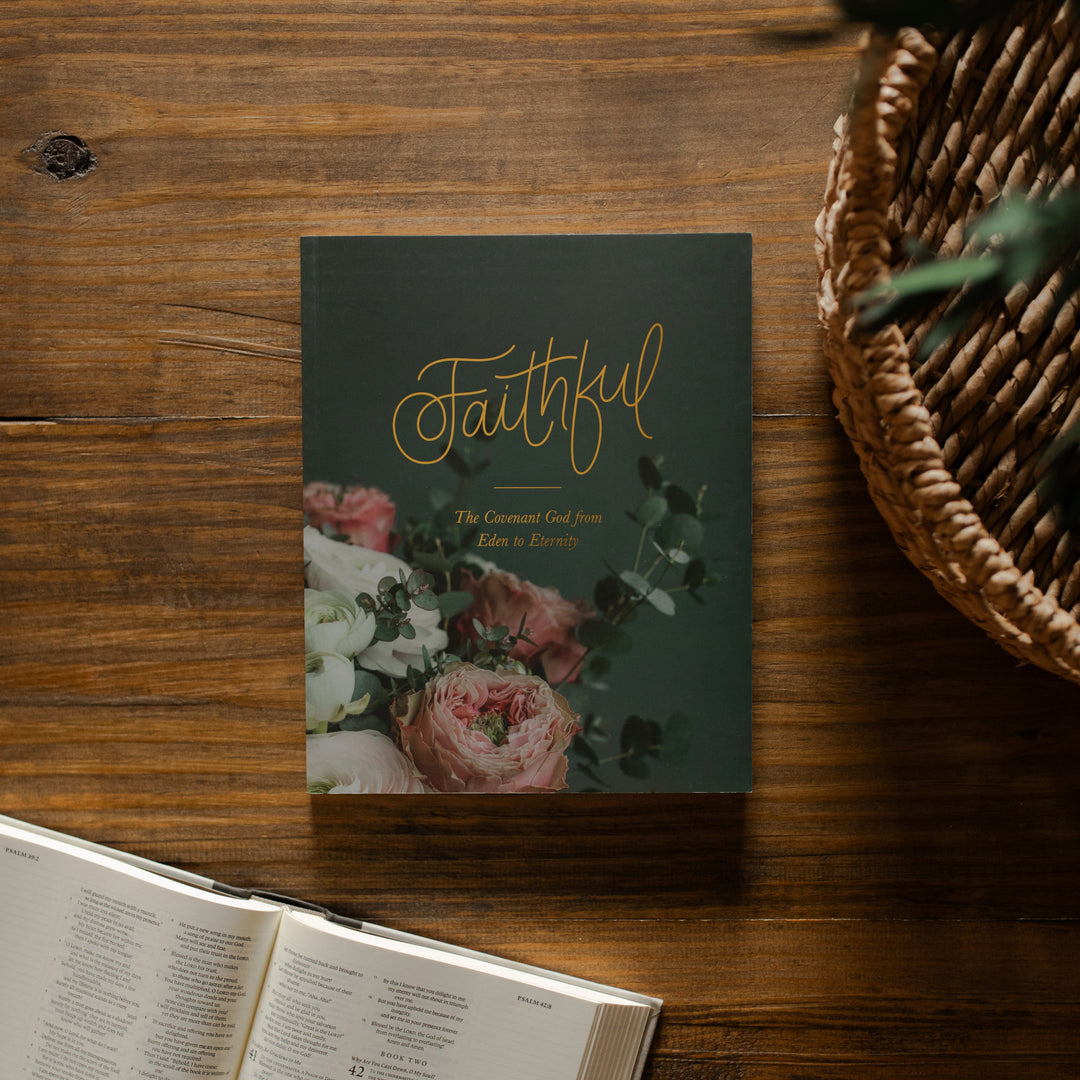
| Amen | From Eden to Eternity Bible Study | The Names of God | Faithful | |||
 Loading price… |
 Loading price… |
 Loading price… |
|||
| Add to Cart | Add to Cart | Add to Cart |