





God has graciously given my wife and me three children: two boys and a newborn girl. Our little girl was born in April, and within a week our boys started asking some pretty big questions. One morning, our eight-year-old came into the room and asked, “Hey Dad, what if Jesus comes back while there are babies? Will they go to heaven?” After answering his question, our five-year-old asks from the other room, “How will Margot [our newborn] know about how Jesus died for our sins if she wasn’t there?” To his question, I responded, “Well, we’ll have to teach her, won’t we?”
My children are no strangers to asking big questions, and if your children are anything like mine, you’ve got your work cut out for you when it comes to answering them. We have the great privilege of making disciples of our children, teaching them to observe all that Jesus has commanded us (Matthew 28:18–20). And when they ask big questions, that’s our moment to make an impact for the glory of God.
Why Do Children Ask Big Questions?
In my personal reading on the same morning I was asked those two questions, I read John 14. In this chapter, the disciples ask Jesus a couple questions of their own:
“Lord,” Thomas said, “we don’t know where you’re going. How can we know the way?” (John 14:5).
Judas (not Iscariot) said to him, “Lord, how is it you’re going to reveal yourself to us and not to the world?” (John 14:22).
This is not uncommon. Pick up any of the four Gospels, and you will soon find the disciples asking Jesus some pretty big questions. Then, look at Jesus. See how He answers their questions, teaching them the Word and will of God. This is precisely how the Israelites were commanded to teach the next generation under the Old Covenant:
When your son asks you in the future, “What is the meaning of the decrees, statutes, and ordinances that the LORD our God has commanded you?” tell him, “We were slaves of Pharaoh in Egypt, but the LORD brought us out of Egypt with a strong hand” (Deuteronomy 6:20–21, emphasis added).
In the future, When your children ask you, “What do these stones mean to you?” you should tell them, “The water of the Jordan was cut off in front of the ark of the Lord’s covenant. When it crossed the Jordan, the Jordan’s water was cut off.” Therefore these stones will always be a memorial for the Israelites (Joshua 4:6b–7, emphasis added).
God has created children to be curious observers who ask a lot of questions, not because He wishes to annoy or overwhelm us but so that we will have ample opportunities to point our children to the truth of who God is and what He has done. Today, our children may not ask about a stack of stones, but they likely ask about our observance of the Lord’s Supper, a different kind of memorial for the people of God.
They likely ask about the religious practices and moral decisions God calls us to as His people: “Why do we do this?” or “Why don’t we do that?” And we get to teach them how our obedience to the Lord is grounded in a greater deliverance than what Israel experienced in the Exodus: the death and resurrection of Jesus. This is ordinary discipleship. As parents, we do not shut down big questions—we invite them, knowing that this is God’s design for passing the faith to the next generation.
The Bible Gives Us Answers
David declares, “One generation will declare your works to the next and will proclaim your mighty acts” (Psalm 145:4). When I answered my five-year-old’s question, I had this verse in mind. Teaching our newborn the glorious news of the gospel is something our whole household will get to do, and this is by God’s design. After all, the Scriptures are not just for us, but they’ve been recorded and preserved “for a later generation, and a people who have not yet been created will praise the LORD” (Psalm 102:18).
This is how Asaph puts it in Psalm 78, thinking generations ahead:
He established a testimony in Jacob and set up a law in Israel, which he commanded our ancestors to teach to their children so that a future generation— children yet to be born—might know. They were to rise and tell their children so that they might put their confidence in God and not forget God’s works, but keep his commands (Psalm 78:5–7).
Now, lest we think that under the New Covenant the responsibility to disciple the next generation has shifted from the home to the Church, we must consider passages like Ephesians 6:4, which reads, “Fathers, don’t stir up anger in your children, but bring them up in the training and instruction of the Lord.” This is how Timothy came to faith, a faith that first dwelt in his mother, Lois, and grandmother, Eunice (2 Timothy 1:5). “From infancy,” Timothy knew “the sacred Scriptures, which are able to give you wisdom for salvation through faith in Christ Jesus” (2 Timothy 3:15).
Do you see in these passages that God has not just given us curious children but a means to answer their big questions? Notice how He’s provided “a testimony in Jacob,” a “law in Israel,” “instruction of the Lord,” and “sacred Scriptures.” In other words, God has given us the answer key. Sixty-six glorious books of infallible truth for our children to learn and to enjoy. And it is our duty to help them acquire a taste for it, that they “may grow up into” salvation (1 Peter 2:2).
Let the Little Children Come
So, how can we ready ourselves for the big questions?
First, we may need to begin by adjusting our posture. Let’s be realistic—most of us have our hands full when the barrage of questions comes. And yet we must listen to perhaps the busiest Man on the planet (Jesus) when He says, “Let the little children come to me and do not hinder them, for to such belongs the kingdom of heaven” (Matthew 19:14, ESV). Our children’s questions are not a hindrance to our kingdom work. They are a primary means of it. Let them come. Let them ask. (Even if it’s past their bedtime!)
Second, having adopted such a posture, we need to be sure we have something to give in answer to their questions. We need to ensure that the well of God’s Word in our hearts does not run dry. By finding a regular rhythm of filling ourselves with God’s Word, we will be storing up rich truths, not only for ourselves but for our children when the time comes.
Finally, in case you feel overwhelmed at this point, allow me to put you at ease with this simple truth: No one is truly sufficient for this task. There will be questions we cannot answer and moments our minds are spent. But the good news is that we are not alone. God has entrusted the entire Church with the discipleship of the next generation. So let us rejoice in the fact that we are united by faith to a body of believers, many of whom are much smarter than we are!
So make the most of your local church. Ask your children’s big questions in your Sunday school class or Bible study group. Email or call your pastor and invite him into the conversation. Then, watch how the Lord ministers to your family through the gift of His Church. Praise God for curious children, for the sufficiency of Scripture, and for the fellowship of His Church.
Author Bio
K. Jack Faught serves as Associate Pastor at Parsons Baptist Church in Columbus, Ohio. He is pursuing a D.Min. in Applied Theology from Southern Baptist Theological Seminary. Jack lives in Columbus with his wife, Claire, and their two sons. He enjoys discipling his boys, making his wife laugh, and spending time with his church.
Unlock a 10% off coupon!
Additional Resources:
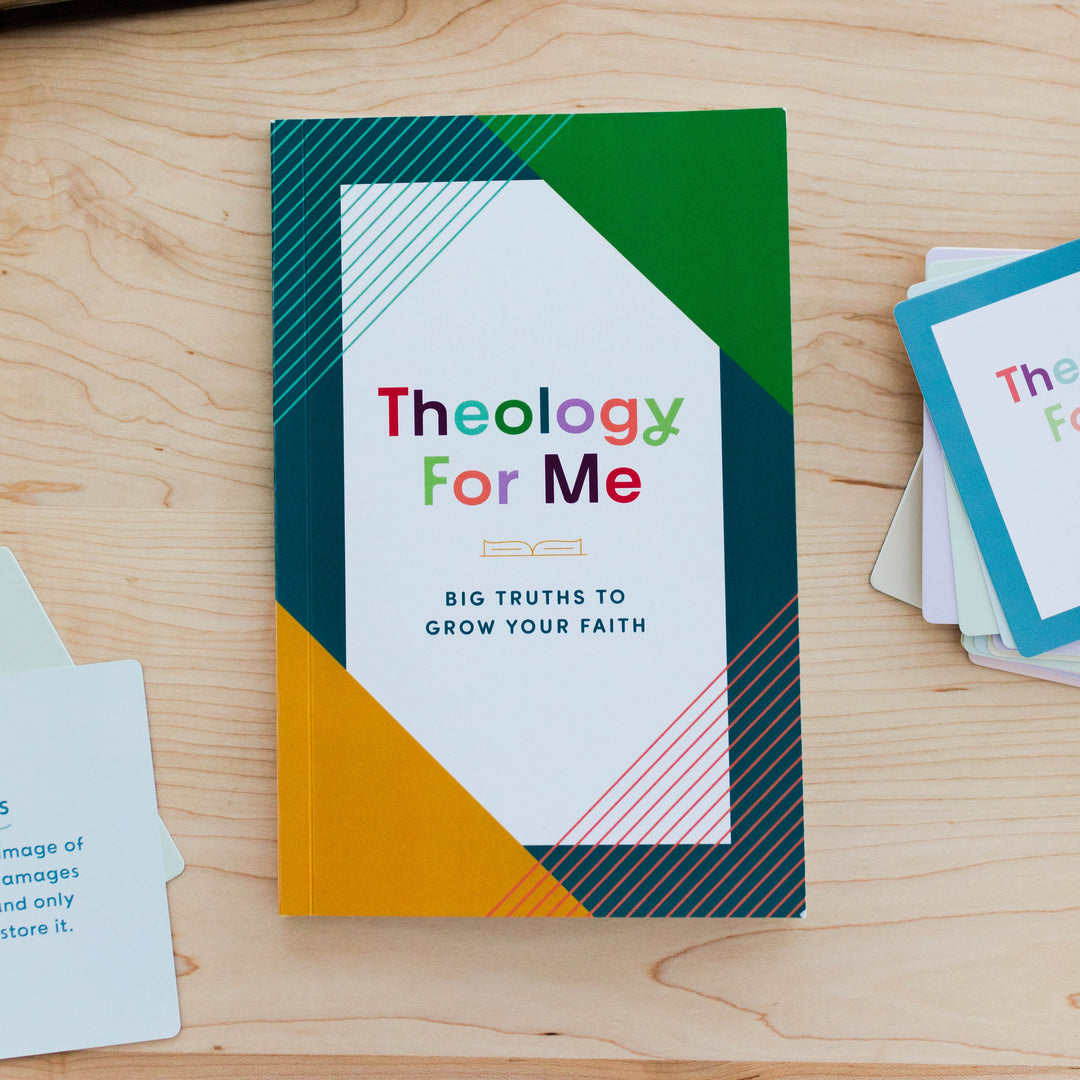
| Theology For Me: Big Truths to Grow Your Faith | All About Jesus | A Family Devotional | Christ-Centered Family | |||
 Loading price… |
 Loading price… |
 Loading price… |
|||
| Add to Cart | Add to Cart | Add to Cart |