





Let’s try some word association. I’ll give a word and then you respond with the first word that comes to your mind.
“Eulogy.”
What was your response? Maybe it was “death,” but probably it was “funeral.” It makes sense. I can’t tell you the last time, if ever, I used or heard the word “eulogy” in another context.
The opening verses of Ephesians (Ephesians 1:3–14) are a eulogy, perhaps of a truer kind. Paul’s words, however, are not a funeral hymn. Rather, they are a delivery of what God has done and is birthing through Christ, creating an atmosphere of worship, hope, and love.
In its simplest form, a eulogy is a “good word” (eu = well/good + logia = speaking/word). When Paul uses words like “praise” and “blessing” and “pleasure,” he’s directly eulogizing, because the roots of those words in Greek connect to our English word for “eulogy.”
Later in the letter, there will be plenty of directives and imperatives for living a life worthy of our call (Ephesians 4:1). Yet the first priority is recognizing what God has done, pointing to our identity as the Church, which, at the core, is about our union with Christ. The relationship between doing (mission) and being (identity) is summarized by Simon Chan: “The mission of the church is the extension of the divine mission of drawing all people into the divine life through the church. In short, communion is what ultimately defines the church while the work of mission is the means to that end.”1
Paul can barely contain himself in speaking good about God and our union with Him. In the NIV, Ephesians 1:3–14 has 282 words in eight sentences, but in the original language, all twelve verses are one very long sentence. (Obviously, Paul didn’t have Mrs. Clemens, my fourth-grade teacher, to teach him about the perils of run-on sentences.) God is praised for such things as rescuing and forgiving us, for giving us knowledge and the Holy Spirit, and for adopting us.
Spirit Is Thicker than Blood
For he chose us in him before the creation of the world to be holy and blameless in his sight. In love he predestined us for adoption to sonship through Jesus Christ, in accordance with his pleasure and will (Ephesians 1:4–5, NIV).
My dad was adopted in his teenage years. He grew up in an abusive and apathetic family environment that my grandparents rescued him from. When I first found out about this as a kid, I remember wishing I had my grandparents’ honorable blood in me. My dad said I did. He didn’t mean that I had some type of blood transfusion, but rather that the influence of love my dad’s adopted parents had on him set a transformative trajectory for me, a generational blessing that transcended biology.
The narrative of Scripture shows that God is the Creator of everyone (Genesis 1), that He loves the whole world (John 3:16), and that He pours out His common grace on all (Matthew 5:45). But that doesn’t mean everyone is a child of God. In fact, we’re naturally born into being children of wrath (Ephesians 2:3). Being adopted is not an automatic occurrence; it is a supernatural mercy. Those who believe and receive Christ (not those who perform and look good) are the ones who are given the right to become children of God (John 1:12).
In Paul’s day, adoption into sonship meant that all the privileges of a naturally-born child were also bestowed upon the not-naturally born child. In adoption, there is no second-class son or daughter. This means, in Christ, all the possibilities that the only begotten Son have, we the Church have. We are truly partakers (even in our suffering) in the divine nature by God’s spiritual blessing (2 Peter 1:4)! Let that sink in for a moment.
The theological legality of adoption is important. When adoption happens, there is a name change. No longer is darkness over us but light (Ephesians 5:8). We’re brought into a different family.
This can be more liberating and challenging than we think. Different temptations come to drive us out of the house. Various entities fight for the family crest over us. “The church must recover its identity as a unique people of God,” Eugene Peterson once said in an interview. “We have become so acculturated to the American culture that we have virtually lost our baptismal identity; it’s so important that we recover our distinctive identity as a people of God and not as a people of American religion.”2
But make no mistake: Any kind of spiritual reality using legal language can’t be held with coldness. The Father’s adoption is according to His good pleasure and will. The motive of God’s blessings isn’t to manipulate or trick us; it isn’t because He disdains us or is trying to fill a lack or is being coerced to just do the right thing. God is pleased to adopt us. It’s out of the riches of God’s grace that He showers—that He lavishes—His blessings on the Church.
God’s Kids Still Take Out the Garbage
The privilege we receive in being part of God’s household is a blessing, and, likewise, so is the responsibility of carrying the family name. It’s interesting that God chose us in Christ to be both holy and blameless. Why are both of these traits articulated? Is being holy not enough? Are they conveying the same thing in a synonymous way, or are they dramatically different?
One way to consider their dynamic is that to be holy is related more to identity, and to be blameless is living out of that identity. Holiness is an identity marker of being set apart, of being something other than the common, and that’s because we are in Christ Jesus. But to be blameless, to be without guilt, means that our actions, both in what we do and don’t do, are aligned with the household values. Part of walking in faith is our actions (blamelessness) catching up to our (holy) identity as God’s kids.
I love how poet-songwriter Andy Squyres creatively speaks about God’s work and the agency He gives us:
[God] is good at creating everything “through himself and for himself” but he is not good at setting your alarm so that you can get to work on time. No, you have to do that. . . . God’s gift to you is the breath in your lungs and the fire in your heart and he insists that you participate in the wide spectrum of creaturely possibility.3
In other words, just as the privileges within adoption are a gift, so are the responsibilities. The Father showing and telling us about the mess around us and saying go take care of it with my Spirit, is part of the benefit of being in His household.
These gifts aren’t something just to be thankful for in the easy and good times. Life is hard more times than we care to admit. We don’t need to be grateful for all circumstances (because not all circumstances are good), but we are encouraged to be thankful in all circumstances, for the spiritual blessings of the Father, through the Spirit, in Christ are still there.
Unlock a 10% off coupon!
Gratitude Without the Filter
The Apostle Paul was likely writing this opening to Ephesians while under house arrest. He was an ambassador of the gospel in chains (Ephesians 6:20), working out the reality of his adoption, proclaiming a eulogy of God’s character in a non-ideal environment.
Maybe today you are rejoicing in life. Hallelujah! But maybe today you are wrestling with parenting, or your job is lifeless. Maybe your spouse feels distant, or there is tension in a friendship. Maybe you’re filled with anxiety, or you are in deep grief over something. Me? I’m personally wrestling with teenage parenting, church division, and financial gymnastics. I get it.
But remember, friends, our situation doesn’t change our family name and what household we belong to. We can be sincerely thankful without the need to Instagram-faith-filter our lives as something perfect and non-messy.
Just like Paul, we can declare and receive the good words of God even in our everyday chains, burdens, and captivity, allowing the love of the gospel to reframe our engagement with life. “Praise be to the God and Father of our Lord Jesus Christ, who has blessed us in the heavenly realms with every spiritual blessing in Christ” (Ephesians 1:3, NIV).
Notes:
Simon Chan, Ontology of the Church (The Encyclopedia of Christian Civilization), Wiley Online Library.
Arthur W. Lindsley, An Interview with Rev. Eugene Peterson, C.S. Lewis Institute.
Andy Squyres, You Don’t Need a Miracle, You Need a Job, Substack
Author Bio
Justin Ryan Boyer is a pastor in Southeastern Pennsylvania and podcast producer of The Quiet Reformation from Netzer.org. He recently contributed a chapter to the book Mystery Revealed: A Collaborative Study on the Book of Ephesians, where he wrote about church unity.
Additional Resources:
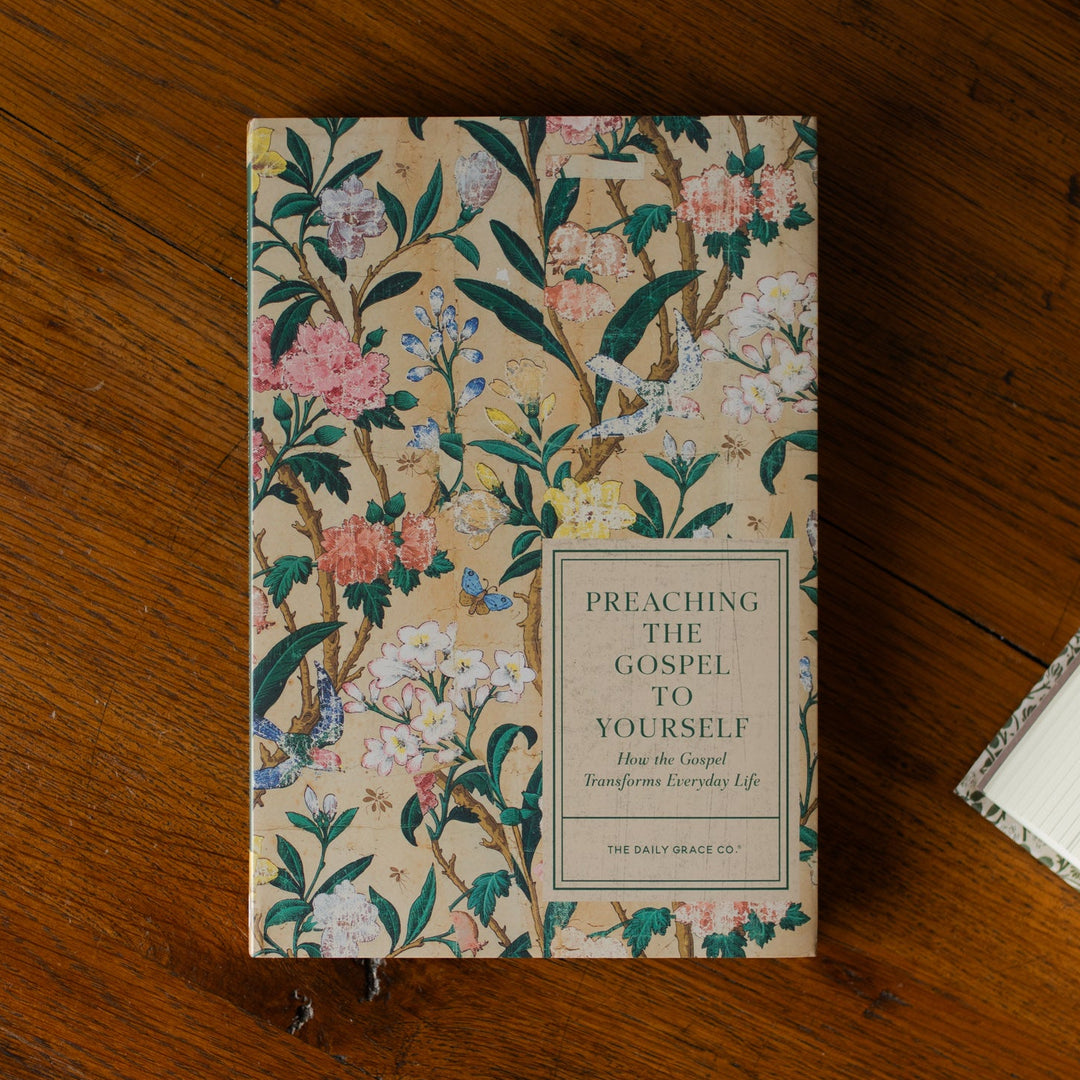
| Preaching the Gospel to Yourself | Abide Bible Study | Made for Him | Rest Bible Study | Will I Make It Through? | ||||
Loading price… |

Loading price… |

Loading price… |

Loading price… |
||||
| Add to Cart | Add to Cart | Add to Cart | Add to Cart |