

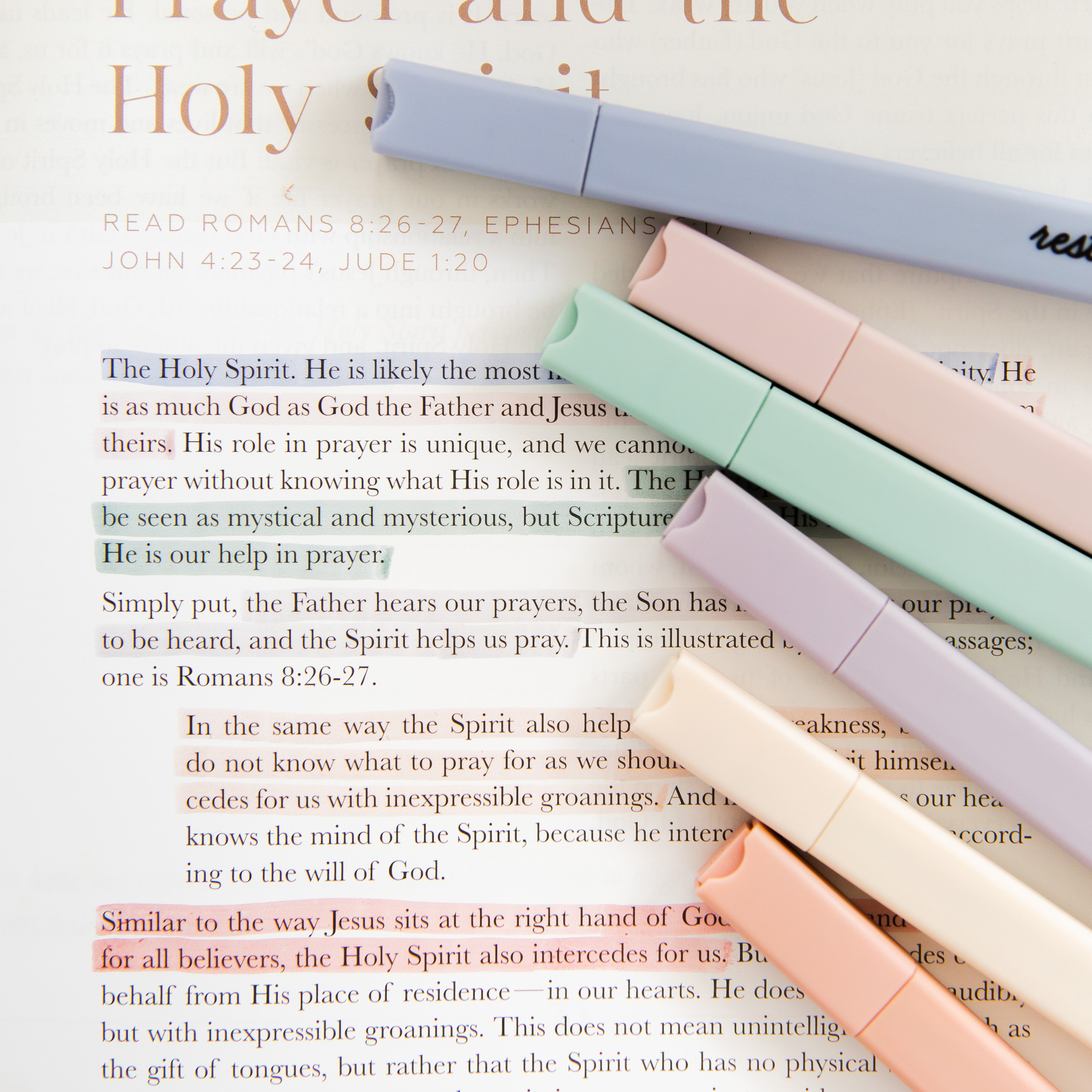






We’re no good at asking for help. In response to offers of assistance—from both God and others—we usually respond with a casual, “No, thanks. I’m good.” But that’s a tough line to hold when you’re limited, weak, and wayward (i.e., human). So, how does the Holy Spirit help us in our war against self-sufficiency and prideful independence—what theologians call autonomy? To answer that question, we need to know something about who the Spirit is. Then we can examine Scripture to see how He works in our lives to draw us into dependence on God.
Who Is the Spirit?
Let me offer three words for our minds to perch on when it comes to identifying the Spirit: life, comfort, and destiny.
Start with life. The Spirit is the source and sustainer of all life. In the beginning, He hovered over the dark waters like a brooding bird (Genesis 1:2), waiting with perfect patience to create a place where creatures would swarm and teem and stomp; where seeds would germinate, pray their soil prayers, and break into the expanse of God-given light; where fish would flick their tails; where wind would blow.
Next is comfort. In John’s Gospel, he calls the Holy Spirit the Paraclete. It’s a Greek word built from para (“close beside” or “next to”) and kaleo (“to call out”). A paraclete is one who calls out next to you and for you—a voice that speaks to advocate, guide, and comfort. In ancient Greek culture, the word was used in legal contexts: A paraclete was a lawyer or legal counselor, speaking on behalf of another. But in John’s Gospel, the meaning is more richly personal. The ESV translates the word “Helper” in that vein, expressing the personal aids Jesus promises: presence (John 14:16), truth (John 14:17), family (John 14:18), teaching (John 14:26), remembrance (John 14:26), and witness (John 15:26). These are all forms of help. The Paraclete is our Helper.
Lastly, we have destiny. You and I have a holy destination, which requires faith and trust to enter. How will we get there? The Holy Spirit. As the Spirit of all life, He brings all living things to their destiny. As He did with creation, so He does with us—God’s new creation (2 Corinthians 5:17). The Spirit leads life to its destiny.
Leaning on the Spirit
If the words life, comfort, and destiny help us understand who the Spirit is, how does the Spirit aid us in the war of autonomy? It is the Spirit’s work of helping that gives us the answer. In a world of false self-sufficiency and pretended independence, the Spirit calls us to take joy in simply asking for help. Let me first connect this to Christ and then to the concrete work of the Spirit inside us.
In many ways, trained in the school of independence, we have forgotten both the necessity and relief of asking for help. But those in the presence of Jesus were quick to make the request, as He knew they would. A young Canaanite woman kneels before Jesus and says, “Lord, help me” (Matthew 15:25). A desperate father pleads for his demon-riddled son, “Have compassion on us and help us” (Mark 9:22). The same father, moments later, even asks Jesus to help his unbelief (Mark 9:24). Help is written all over the rustling leaves of the New Testament. And whom does Jesus send but the Helper?
The ways in which people asked Jesus for help are now the ways in which we ask the Spirit for help. Here are three ways of doing so.
Asking for Truth, Remembrance, and Speech: A Case Study
I’m an introvert, often caught up in my own inner worlds as a reader, writer, and storyteller. Writing a work of fiction such as The White Door will keep my mind in other places for extended periods of time. I emerge from these worlds to engage with those I know and love most deeply: my wife and children, my family, my church, my friends. It’s a bit like living in a log cabin with a roaring fire, emerging from the threshold throughout the day to speak and work with others. It’s a quiet life, and I like it that way.
But I was asked by a good family friend to give a series of talks at his church, focusing on God’s presence. This was something I knew I would need help to do. So I turned to the Helper.
Truth
First, I asked the Helper for truth, since He is the Spirit of truth, and Jesus said He would “guide us into all the truth.” But what does that even mean—to ask for truth? It’s much more than asking the Spirit for facts and information. Truth is, after all, a divine Person, not a packet of information. Jesus probably broke the brains of His disciples when He told them, “I am the way, the truth, and the life” (John 14:6). (He certainly broke mine.)
Because truth is a Person (Jesus), we have to think more personally about truth. In light of John 14:6, Vern Poythress even writes, “Truth is another name for God.”1 What does the Truth do for us and inside us? Go beyond the idea of information. Stare at Jesus, the Person of truth. He saves (Matthew 1:21). He sympathizes (Hebrews 4:15). He prays for us (John 17:20–21). He gives us His peace (John 14:27). He teaches us (Matthew 13:54). He shepherds us (John 10:14). He leads us (Isaiah 11:6). In all these ways and more, He is our loving, sovereign, Satan-conquering Lord. He is our Lord.
When we ask for truth, we ultimately ask for the Lord. Asking for truth is thus asking for a relationship. Yes, we want to know what is true, but never in isolation from the One who is truth. So when we ask for truth, we are asking to see the world and ourselves through God's eyes, through a relationship with Him. We are asking to see each facet of our lives from God's perspective, so far as we can as limited, leaning creatures.
Here’s how that looked in my situation: “Spirit, help me. How do I see this request to speak at a church not just in relation to my excitements and fears and doubts, but in relation to You and what You are doing in my life and in the lives of those around me?”
That’s a big question, isn’t it? Much bigger than simply asking God what is true from a theological standpoint. But God is interested in far more than what we claim to know about Him. He is deeply interested in what He knows about us. That’s not to belittle the importance of doctrine, of theology. It is only to show that God wants more from us than our theology. He wants all of us.
In answer to that prayer, the Spirit led me to think of the prophet Samuel’s words to the people of Israel: “The LORD will not abandon his people, because of his great name and because he has determined to make you his own people.” (1 Samuel 12:22). Do you know what God is doing right now? He's making a people for Himself in Jesus Christ, a people who can only be properly described as being destined for oneness with Him (John 17). God is making a cohort for eternal communion. All over the world, and wherever they are spiritually, people whom God foreknew and foreloved are being called, justified, and glorified (Romans 8:30)—often in a process so slow and quiet that we feel like caterpillars in a chrysalis. Will we ever get out of our little shell and grow? Will we ever fly? The Spirit replies to these questions: Already and not yet. God is sending me, a caterpillar, to encourage them—the others. He is sending me to encourage them with His words—words from the God-breathed Scriptures (2 Timothy 3:16–17). While my anxiety pushes me to think of myself, asking the Spirit for help in the truth is pushing me to think of others. This request to speak is not about me—my fears, my abilities, my ambitions, my feelings. This is about others. This is about a branch of God’s holy caterpillars in chrysalis.
Remembrance
Second, I ask for help with remembrance. Jesus said the Spirit “will . . . remind you of everything I have told you” (John 14:26). Humans are forgetful creatures. Great things open our souls like flower crowns in the sun, and then they fade and disappear. We find ourselves focusing on the immediate, staring at the present, without holding the treasure of the past as we walk into the future. Jesus says the Spirit is Lord of our memories and will bring to us all that Jesus has said. And so I ask the Helper, “What words of Christ do I need to remember as I consider speaking at this church?” Matthew 28:20 flits into view like a sparrow from a thicket: “I am with you always.” I was asked to speak at this church on the presence of God. Could there be any more direct answer to the request for God’s presence? This verse reframed my perspective on the opportunity. Am I nervous? Am I scared? Yes. But am I alone? Never. Jesus told me He would always be with me. In fact, He lives in me, along with the Father and the Spirit (John 14:23; Romans 8:11). I go nowhere alone. Regardless of what I feel or think, I am accompanied by God Himself. Always.
Speech
Third, I ask God to speak. This is not a request for an audible voice inside my head. When I ask God to speak, the Spirit says, Read. And so I did. I read about God’s presence in Genesis 1–3. I read about Moses in his God-tent, glowing with the glory of God. I read about Elijah, who fled in terror only to find God waiting for him and comforting his heart with sweet silence, for God’s covenant would hold. He would do just as He said He would. I read about Jesus marching up a mountain with Peter, James, and John. And—who would have guessed?—Moses and Elijah appearing to speak with Him from beyond the veil of time. My heart feels like a saturated garden in the summer sun. Tendrils are climbing. Roots are burrowing. Leaves are opening like sails. I am opening to the life-giving light of who God is and what he has done in Christ—and what He is still doing by His Spirit, even at this very moment. God is a gardener.
Asking for help in the truth. Asking for remembrance. Asking for God to speak. These are three ways of leaning on the Spirit for help. This is the Spirit of life, the Spirit of comfort, the Spirit of destiny. The Spirit of God assaults our autonomy by repeatedly showing us that life is about leaning. Our hope lies in leaning on our Helper. Not in brute strength. Not in independence. And certainly not in autonomy.
Notes
1. Poythress, Truth, Theology, and Perspective, 25.
Author Bio
Pierce Taylor Hibbs is Senior Writer and Communication Specialist at Westminster Theological Seminary. He is the author of more than twenty books, including Struck Down but Not Destroyed, The Book of Giving, and One with God. His latest book is Our Hope Is in Help (Christian Focus). He and his wife, Christina, live in Pennsylvania with their three kids, Isaac, Nora, and Heidi. Learn more about his work at piercetaylorhibbs.com.
Unlock a 10% off coupon!
Additional Resources for Leaning on God:
| Daily Grace | How Jesus Answers Our Heartache with Himself | Peace Under Pressure | Stress Bible Study | Pray Bible Study | New and Never-Ending Mercies Devotional | ||||

Loading price… |

Loading price… |

Loading price… |

Loading price… |
||||
| Add to Cart | Add to Cart | Add to Cart | Add to Cart |